
In the world of medical electronics, there’s no room for error. Every solder joint, every component placement, and every process step must be flawless, as even the slightest variation can compromise patient safety or lead to costly recalls. In this high-stakes environment, choosing the right reflow oven is far more than just about specifications — it’s about ensuring long-term stability, repeatable results, and most importantly, regulatory compliance. The right equipment will help manufacturers meet the stringent requirements of ISO 13485, protect the integrity of their products, and reduce the risk of compliance failures that could disrupt production and damage their reputation. To learn more about how to choose the right equipment for your manufacturing needs, explore our SMT machine solutions. But how do you choose the right reflow oven that not only meets today’s production demands but also future-proofs your process against evolving standards?
Table of Contents
1. Why Medical Electronics Require a Different Reflow Strategy
1.1. The Unique Demands of Medical Device Production
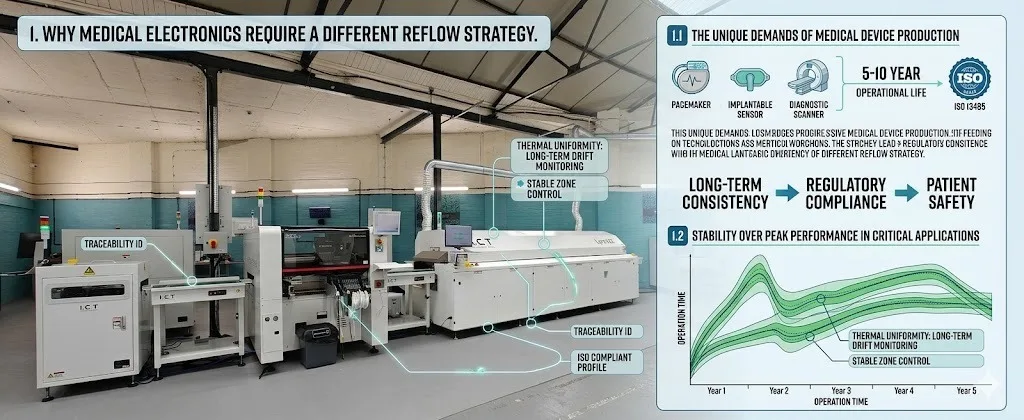
Medical devices often remain in use for five to ten years or longer, and any latent defect in the printed circuit board assembly can trigger serious consequences. Unlike consumer electronics, where occasional failures may only inconvenience users, medical products must perform consistently under strict regulatory oversight. ISO 13485 demands documented evidence of process control, risk management, and traceability throughout the manufacturing lifecycle. Reflow soldering, as one of the most critical steps in SMT assembly, directly influences solder joint integrity, component reliability, and overall device safety. Manufacturers therefore need a reflow strategy that prioritizes controlled, repeatable thermal profiles over raw throughput or peak temperature capability.
1.2. Stability Over Peak Performance in Critical Medical Applications
In medical electronics, stability matters far more than peak performance on day one. A reflow oven that delivers excellent results during initial qualification may still drift over months or years, leading to inconsistent solder wetting, hidden voids, or thermal stress on sensitive components such as sensors, microcontrollers, or implantable-grade parts. The real goal is a process that remains within tight tolerances across thousands of boards and multiple product revisions. This long-term consistency helps prevent costly field failures and supports the “explainability” required during FDA-related reviews or customer audits. In short, medical teams buy confidence in the process, not just a high-spec machine.
2. The Hidden Risks of Choosing a Standard Reflow Oven for Medical Electronics
2.1. Temperature Uniformity vs. Apparent Accuracy: Why Precision Isn’t Enough
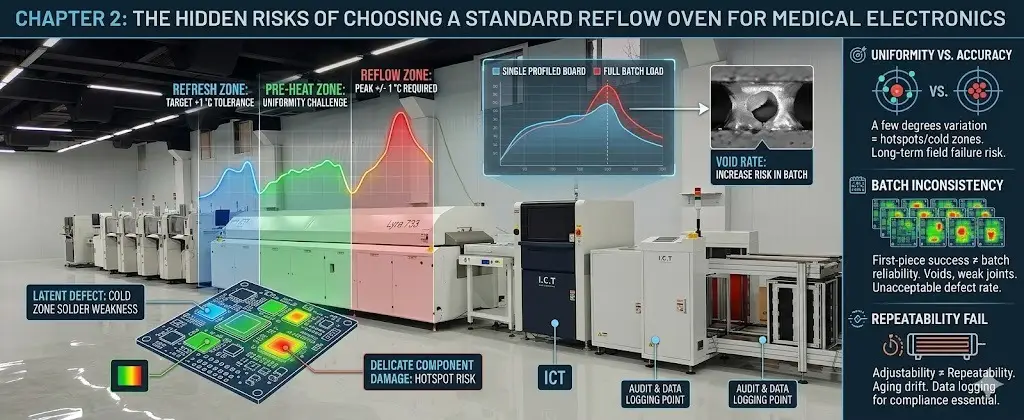
Many suppliers emphasize temperature accuracy—the ability of the oven to reach a set point. In medical applications, however, temperature uniformity across the entire board and between boards proves far more important. Even a small variation of a few degrees can create hot spots that damage delicate components or cold zones that produce weak joints. Over time, these inconsistencies compound, especially on boards with mixed thermal masses. Standard ovens designed for general electronics often lack the advanced convection systems or multi-zone control needed to maintain uniformity within ±1–2 °C across the process width, increasing the risk of latent defects that only appear after prolonged field use.
2.2. From First-Piece Success to Batch Failure: The Hidden Risk of Inconsistent Results
A single profiled board may pass initial inspection, yet the same settings applied to a full production run can yield different outcomes due to oven loading effects, conveyor variations, or ambient conditions. In medical manufacturing, first-piece success does not guarantee batch reliability. Voids in critical BGA or QFN joints, inconsistent solder wetting, or uneven intermetallic formation can weaken connections and reduce heat dissipation. These issues raise the probability of early failures in life-support equipment or diagnostic devices, where even a low defect rate becomes unacceptable.
2.3. Profile Adjustability vs. True Process Repeatability: How to Ensure Consistent Quality
Modern reflow ovens allow easy profile adjustments, but adjustability alone does not equal repeatability. Equipment aging, heater drift, or changes in airflow can cause the actual temperature experienced by the board to shift gradually. Medical production requires documented proof that every board receives the same controlled thermal experience. Without robust long-term stability and data logging, manufacturers struggle to demonstrate compliance during audits or to explain process variations if questions arise later.
3. Key Factors That Ensure Medical-Grade Reflow Reliability
3.1. Temperature Uniformity and Long-Term Consistency for High-Reliability Electronics
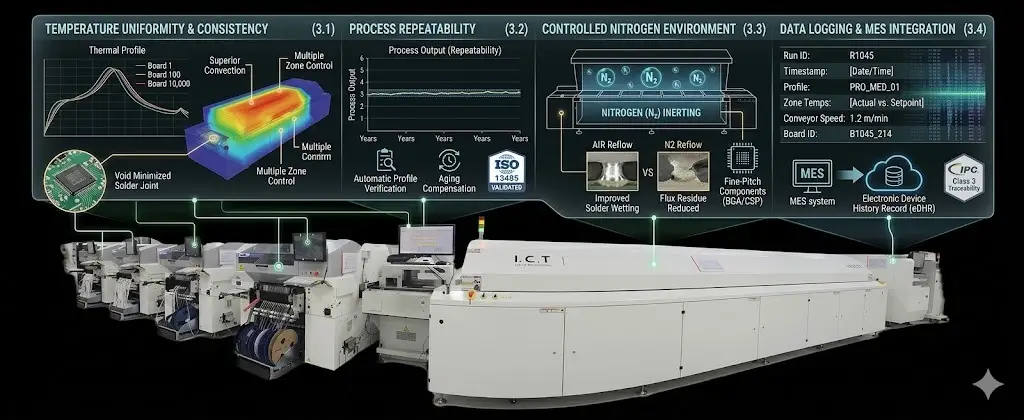
Superior convection designs and multiple independently controlled zones help maintain tight temperature uniformity. Look for ovens that achieve consistent results across the full conveyor width even under varying load conditions. Long-term consistency also depends on minimal drift in heating elements and sensors. Regular verification against baseline profiles ensures the process stays within acceptable limits, protecting sensitive medical components from thermal stress while delivering strong, void-minimized solder joints.
3.2. Process Repeatability and Control Over Equipment Aging and Drift
Repeatability over months and years separates medical-grade solutions from standard equipment. Features such as automatic profile verification, real-time monitoring, and compensation for aging help maintain the same thermal experience board after board. This control reduces the need for frequent manual recalibration and provides the objective data required for ISO 13485 process validation and risk management documentation.
4. Designing a Reflow Process for Compliance, Not Just Production
4.1. Building Compliance into Every Stage of the Process, Not Just the Equipment
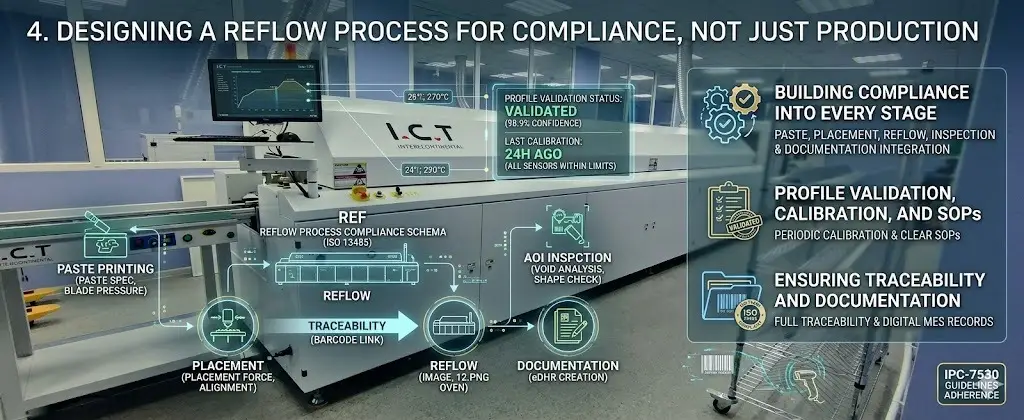
A high-quality reflow oven forms only one part of a compliant system. True compliance emerges from the entire process—material handling, paste printing, placement, reflow, inspection, and documentation. The oven must support repeatable thermal profiles that align with validated SOPs and risk assessments. Manufacturers who treat reflow as an isolated step often discover gaps during audits; those who integrate it into a holistic, documented process build stronger defenses against compliance issues.
4.2. Profile Validation, Calibration, and SOPs: Essential Steps for Medical Device Manufacturing
Profile validation should occur regularly, not just at initial setup. Periodic calibration of thermocouples and oven sensors, combined with clear standard operating procedures, ensures the process remains under control. Medical teams benefit from ovens that simplify these tasks through built-in verification tools and exportable reports. Following IPC-7530 guidelines for temperature profiling further strengthens the validation package and demonstrates due diligence to auditors.
5. Common Mistakes Medical Manufacturers Make When Choosing Reflow Ovens
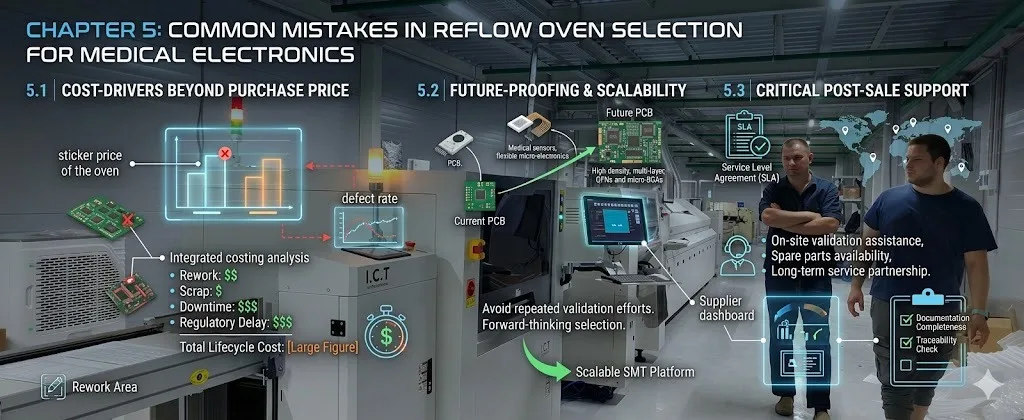
5.1. Focusing Solely on Zone Count or Initial Price: What You’re Really Paying For
Counting heating zones or comparing sticker prices often leads to false economy. An inexpensive oven may require frequent maintenance, produce higher defect rates, or lack the data capabilities needed for medical compliance. The true cost includes downtime, rework, scrap, regulatory delays, and potential brand damage from field failures.
5.2. Ignoring Future Product Changes and Scalability in Medical Manufacturing
Medical product lines evolve. New components, denser boards, or stricter requirements can appear within a few years. Choosing an oven without room for growth or flexible profile control forces premature replacement and repeated validation efforts. Forward-thinking selection considers scalability and long-term support.
6. How to Choose the Right Partner for a Stable, Compliant SMT Process
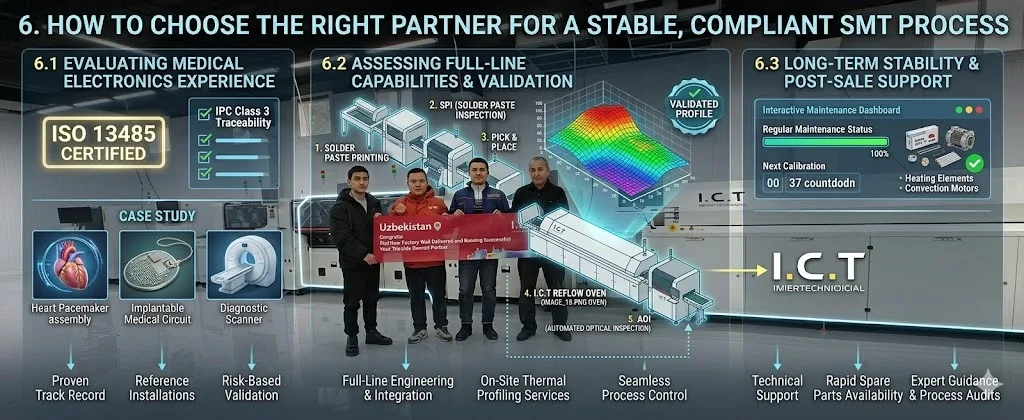
6.1. Evaluating Experience in Medical Electronics Manufacturing
Suppliers with proven medical electronics experience understand the unique demands of ISO 13485, IPC Class 3, and risk-based validation. They can share case studies, reference installations, and practical advice on building compliant processes rather than simply selling hardware.
6.2. Assessing Profile Support, On-Site Validation, and Full-Line Capabilities for Medical-Grade Production
The best partners offer detailed profile development support, on-site thermal profiling services, and the ability to integrate the reflow oven into a complete SMT line that includes SPI, placement, and AOI systems. This holistic approach ensures the entire process works together seamlessly.
7. Summary of Key Points
7.1. Recap of Key Takeaways: Compliance, Stability, and Long-Term Support
Successful reflow oven selection for medical electronics rests on three pillars: process stability that lasts for the product’s lifecycle, full traceability and documentation to support compliance, and a trusted partner who understands the industry’s stringent requirements. Focus on temperature uniformity, long-term repeatability, appropriate use of nitrogen, robust data logging, and integration with MES systems. Avoid common pitfalls such as overemphasizing initial specifications or underestimating support needs. By prioritizing a controlled, explainable, and repeatable process over isolated machine features, manufacturers reduce risk, simplify audits, and deliver safer, more reliable medical devices.