
Table of Contents
Introduction
A GFA7.KF462.83G texture is known to refer to a particular type of digital texture that is primarily utilized in 3D models, games, and computerized graphics design processes. It is referred to as a texture format, which offers detailed images but at the same time can be highly compressed in order to ensure efficient use and performance. These textures enable designers to make realistic objects such as metallic, stony, fabric, and environmental textures in any digital setting. The advantage of this particular type of texture is that it is highly compatible with most of the current rendering software.
What is GFA7?KF462.83G Texture?
GFA7.KF462.83G Texture is a digital format of textures that have been developed for use in more advanced areas like game environments and other renderings. The texture is meant to improve the surface realism without necessarily reducing performance or increasing file size.
- Provides a detailed and realistic surface appearance.
- Optimized for efficient storage and rendering performance.
- Suitable for gaming, 3D modeling, and simulation projects.
- Supports high-resolution visual content with reduced resource usage.
- Enhances overall graphic quality in digital environments.
Applications of GFA7.KF462.83G Texture in Romanian Design Projects
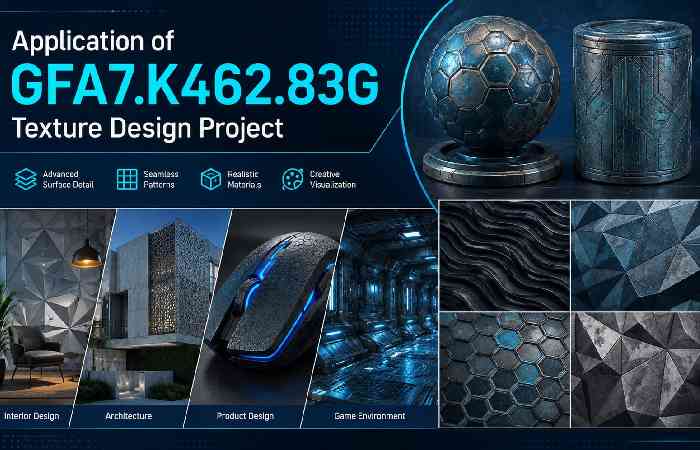
Texture GFA7.KF462.83G can find practical application in different design projects in Romania, where realism and quality of graphics are critical for success. The designer may utilize the specified system of texture in creating visualizations for architecture, gaming worlds, prototyping products, and multimedia projects. In addition, in light of the rising popularity of digital design in Romania, textures like GFA7.KF462.83G can find broad use.
| Design Sector | Application | Benefits |
| Architectural Visualization | Creating realistic building exteriors and interiors | Enhanced visual presentation and client engagement |
| Video Game Development | Designing detailed environments and objects | Improved realism and immersive gameplay |
| Product Design | Developing digital prototypes and product renders | Accurate material representation |
| Virtual Reality (VR) Projects | Building interactive 3D experiences | Greater user immersion and visual quality |
| Animation & Multimedia | Producing films, advertisements, and motion graphics | High-detail textures with optimized performance |
| Cultural Heritage Reconstruction | Recreating historical Romanian landmarks digitally | Realistic preservation and educational value |
How to Install and Use GFA7.KF462.83G Texture?
Installation and utilization of GFA7.KF462.83G Texture usually requires importing the texture into compatible 3D modeling/rendering/visualization software. Adding the texture to your project means you will use it to enhance the visuals of certain objects, materials, and/or environments within your project. Proper setting up of texture options will ensure that you get an optimal quality/performance balance out of your texture.
Installation Steps
- First, download the GFA7.KF462.83G Texture.
- Check whether your software supports this texture format.
- Import the texture into your project’s asset/material library.
- Either create new or choose existing material to apply your texture to.
- Apply your texture to specific texture channels like diffuse, normal, roughness, etc.
- Save the project; refresh the scene if needed.
How to Use the Texture
- Use this texture to enhance objects within your scene.
- Set up the correct scale/mapping options of your texture.
- Correctly set up lights to emphasize the texture better.
- Properly adjust the resolution options.
Best Practices
- Keep backup copies of original texture files.
- Use texture compression when working on large projects.
- Organize texture assets in clearly labeled folders.
- Regularly update rendering software for compatibility improvements.
- Preview textures in different environments to ensure consistent results.
Use of GFA7.KF462.83G Texture in the Architecture Industry
Texture is an element that can be incorporated into architectural visualization for the purpose of making very realistic depictions of structures and interior spaces. With textures applied to the surfaces of walls, floors, roofs, and construction materials, architects are able to produce highly accurate depictions of their projects. Using textures will allow the clients to grasp the concept behind the design even before construction begins.
Benefits for Architectural Visualization
Better Material Realism
The realism of materials like concrete, stone, wood, glass, and metal can be improved, producing more realistic presentations of the project.
Better Client Comprehension
The high quality of textures makes it easier to comprehend 3D models and renderings, making it possible to imagine how the building will look.
Improved Performance of Rendering
Texture optimization means less usage of computer resources without loss of quality, which is vital when creating realistic architectural images.
Virtual Tours Support
Detailed textures make virtual reality and virtual tours more realistic, helping everyone examine a building design in VR space.
Challenges of Using GFA7.KF462.83G Texture in Digital Projects
Even though the GFA7.KF462.83G Texture adds more realism to an image; the application of the same into a digital design faces certain challenges. For example, high-resolution textures require a lot of storage and consume a lot of processing power. Incompatibility among various software is also another issue that complicates the production process.
| Challenge | Description | Potential Impact |
| Large File Sizes | High-detail textures can consume substantial storage space. | Increased project size and longer download times. |
| Rendering Performance | Complex textures require additional GPU and CPU resources. | Slower rendering and reduced application performance. |
| Software Compatibility | Some tools may not fully support specialized texture formats. | Workflow interruptions and conversion requirements. |
| Memory Consumption | Detailed textures use more system memory during processing. | Performance issues on lower-end devices. |
| Optimization Requirements | Textures often need compression and adjustment for efficiency. | Additional development and testing time. |
| Asset Management Complexity | Managing multiple texture versions can be challenging. | Increased project organization effort. |
| Cross-Platform Deployment | Different devices may handle textures differently. | Inconsistent visual quality across platforms. |
| Maintenance and Updates | Texture libraries require regular updates and optimization. | Higher long-term project maintenance costs. |
Role of GFA7.KF462.83G Texture in Romanian 3D Modeling and Visualization
GFA7.KF462.83G Textures play a very important role in 3D Modeling & Visualization projects within Romania. It is attributed to the fact that textures help raise the level of reality in digital designs. With the use of current texture technology, designers, architects, and visualizers are able to develop realistic objects like buildings, landscapes, products, or any other type of virtual object.
Key Contributions to 3D Visualization
Advantages of Realistic Textures in Digital Modeling
High levels of realism are achievable through detailed textures that can simulate stone, wood, metal, and concrete to achieve realistic representations of materials.
Effective Visualization of Architecture
Architectural modeling companies can produce photorealistic images and presentations of buildings using accurate textures of construction and design components.
Efficiency in Large Projects
Optimized texture management ensures better rendering results while handling large files from different digital elements in architectural visualization software.
Benefits of Game Development and VR
Game designers and VR experts can implement advanced texture modeling into their virtual environments for enhanced gaming experiences.
Comparison Between GFA7.KF462.83G Texture and Traditional Texture Formats
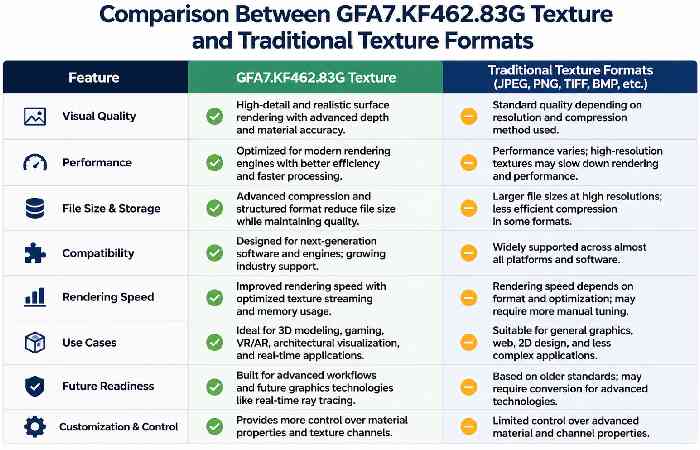
GFA7.KF462.83G Texture can be defined as a modern texture format that strives to provide both improved graphical display and effective rendering. Unlike other forms of textures, it strives to combine high-quality graphical display with resource efficiency. The selection between an advanced texture format and a standard one is determined by various factors.
| Feature | GFA7.KF462.83G Texture | Traditional Texture Formats |
| Visual Quality | High-detail and realistic surface rendering | Standard detail levels depending on resolution |
| Performance Optimization | Designed for efficient rendering workflows | May require additional optimization |
| File Management | Structured for modern digital environments | Widely supported but less specialized |
| Rendering Speed | Optimized for advanced graphics engines | Performance varies by format and engine |
| Storage Efficiency | Often includes improved compression methods | Can consume more storage at high resolutions |
| Compatibility | May require specific software support | Broad compatibility across platforms |
| Use Cases | 3D modeling, gaming, VR, and imagining | General graphics, web, and hypermedia projects |
| Scalability | Suitable for complex, large-scale scenes | Better suited for standard applications |
| Maintenance | May need specialized workflow management | Easier to manage due to widespread adoption |
| Future Readiness | Aligned with modern rendering technologies | Based on established industry standards |
Future of Advanced Texture Technologies in Romania
The development of textures is anticipated to become even more relevant in connection with the expanding industry of digital design, gaming, architecture, and visualization in Romania. Modern techniques of texture creation will facilitate better visual results as well as better performance. The emergence of AI-powered design software and real-time rendering will further facilitate this process.
Key Future Trends
- Greater use of high-resolution textures in architectural visualization.
- Increased adoption of advanced textures in game development and VR projects.
- Integration of AI-powered texture generation and optimization tools.
- Improved real-time rendering capabilities for interactive applications.
- Enhanced support for AR/VR experiences across industries.
- More efficient texture compression and storage technologies.
- Growing demand for realistic digital twins and smart city visualizations.
- Expansion of texture-based workflows in education and cultural heritage preservation.
Conclusion
Texture is a new generation of digital texturing that promises improved visual quality, realism, and performance for any creative project that might benefit from its capabilities. Such programs can be used for architectural purposes, creating 3D models, playing video games, working in virtual reality, and even for visualization. Even though issues like compatibility and optimization may occur, appropriate usage will maximize the benefits of texture technology. With ever-growing capabilities of modern graphic technologies, texture solutions are sure to become more and more relevant in the future.